
Easy May
some recommendations

May has been a relatively low-key month for me, having just finished a large production and with the next commission not starting until June, it’s allowed me to spend more time on those activities, like research and exploration, that are a significant part of being an artist but, for me at least (I’d be interested to know if anyone else feels the same), feel self-indulgent and come with a certain level of guilt. In the name of research, I’ve been spending time watching, listening and attending things as much as I can so here’s a few of them I found myself thinking about weeks after:
Einkvan (Coronet Theatre)
I talked a bit about Fosse’s book Septology, which I absolutely loved, in a previous post so I was thrilled to see that The Coronet was hosting a small run of Det Norske Teatret’s production of Einkvan. The play, which largely consisted of intimate monologues, shifted perspective in a way that I’ve not seen before: the minimal set design incorporated translucent curtains that completely obfuscated the playing space so that the actors behind them appeared as smokey shapes that wandered across the stage. Above the curtains were two large digital displays that focused on the actors’ faces in an almost intrusive way, as well as displaying the English surtitles (the play was entirely spoken in Nynorsk). It took me a while to realise that what was being shown on the screens wasn’t a pre-recorded film but real-time footage broadcast by two cameras being operated by a crew on stage with the actors, the curtains making it impossible to discern between cast and crew. On stage, a mother and a father make desperate attempts to connect with their son, who wants nothing to do with them; these attempts at a relationship are mirrored by doppelgängers (a Jon Fosse trope) who echo the same sentiments. I realised some days after the performance that what made it so affecting was how it played with frustration. I felt a certain amount of it when I understood that the translucent curtains would block the action for the entirety of the play and the audience wouldn’t be appeased by a reveal in the next act. I desperately wanted to see the actors on stage in full but this denial was a perfect mirror to the rejection they were receiving form their son. There’s something about the potential criticism of the production’s execution being intentional that really dug into me.
Ice by Anna Kavan
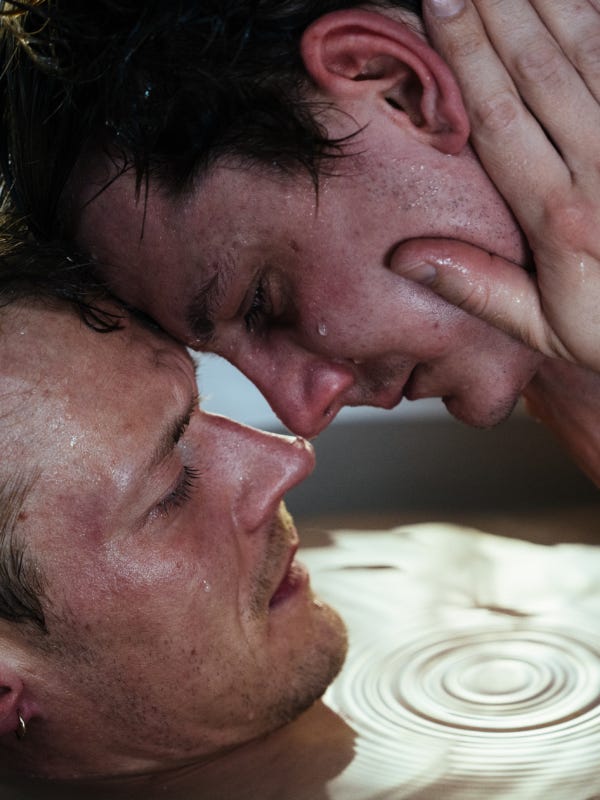
This is one of those books that can’t really be read with a formalist approach. Its author, had a longstanding struggle with depression and heroin, legally prescribed to her by a doctor over the course of thirty years, and was committed to an asylum after a suicide attampt in the early 1940s. The book was written a few years before her death in 1968 and, in my opinion, has to be read within the context of her life. Ice is set during an apocalypse in which a monolithic ice-shelf caused by nuclear winter is slowly engulfing the earth. The protagonist is obsessively pursuing a girl across the globe whilst coming to terms with his conflicting feelings for her. Whilst this book would fit firmly within the sci-fi genre, the apocalyptic setting is more of a vessel for the exploration of the violence and oppression that Kavan encountered in her life; the protagonist, a man who is given a hero-arc, obsesses over his need to “save” the girl from another wealthy gentleman. Except, the saving is described as a need for possession, his love for her often taking the form of violent fantasies and the girl is described with a fragility that is constantly on the brink of shattering. There are clear parallels to be drawn between the author’s personal life and the girl in the novel, forced adoption of the role of victim and patient by the hands of men.
The End (2025)
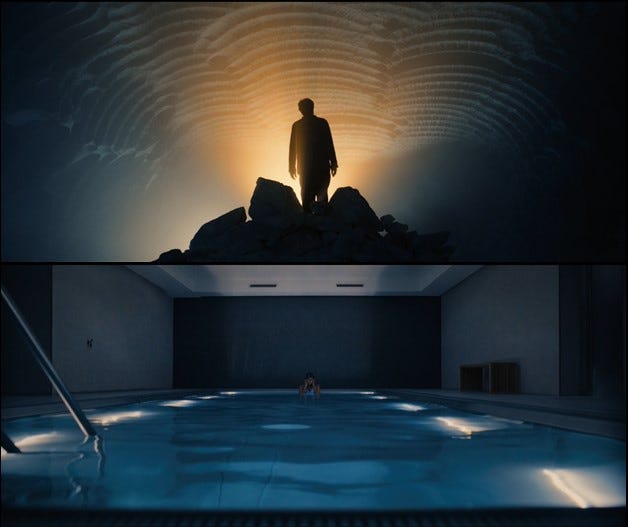
In keeping with the apocalyptic theme, I recently watched Joshua Oppenheimer’s The End, which received some pretty damning reviews from critics who mainly seemed baffled by the writer and director’s choice to make the film a musical. Set in an underground bunker that could more closely be described as a mansion, the film follows the lives of a family and some of their close friends 25 years after climate collapse has caused a major world catastrophe. Following the discovery of an outsider that has managed to make her way to their bunker, the family are forced to deal with their privilege and the things they did to achieve it. There’s a complexity to each of the characters that is put on display via the fact that they’ve been in isolation for so many years, the idiosyncrasies of the family unit on full show. Song is used according to the traditional musical theatre adage: if you can’t say it, sing it, their innermost feelings expressed in song because, in such close proximity to each other for such a long time, a certain facade has been kept up in order for day-to-day life to be bearable. Slowly, the facade crumbles with the arrival of the new guest and under the scrutiny of the outsider we begin to see that what has been seen as normal for such a long time is ridiculous; the family friends that have been living with them are treated as such on the surface but are actually filling the roles of servants and butlers. There’s something there about the performativity of persona versus the pure expression of song which has stayed with me.
Some music, I’ve been listening to:
George Crumb - An Idyll For The Misbegotten